

What is Near-Infrared (NIR)? The Story of Unseen Half of Sunlight
When we think of sunlight, we often only imagine the ‘visible light’ that our eyes can see. However, in reality, nearly half of the solar energy reaching the Earth consists of invisible Near-Infrared (NIR) radiation.
Recently, near-infrared technology has emerged as a key focal point in fields such as smart agriculture, plant growth lighting, and bio-lighting. Why is this invisible light receiving so much attention? Here is a simple breakdown from the basic definition of NIR to the composition of the solar spectrum.
1. What is Near-Infrared (NIR)?
- Wavelength Range: Generally 700nm to 1400nm (In plant growth and bio-photonics, the 700~1000nm band is most frequently utilized).
- Key Characteristics: Although invisible to the human eye, NIR possesses unique properties that allow it to penetrate deeply into organic tissues, deliver thermal energy efficiently, and trigger biological responses.
💡 Summary in One Line
Positioned right next to visible red light (700nm), NIR is a ‘hybrid wavelength band’ that combines the optical properties of visible light with the thermal and biological response characteristics of infrared.
2. Half of Solar Energy: NIR Ratio in Sunlight
Analyzing the solar spectrum reaching the Earth reveals an interesting fact about sunlight composition:
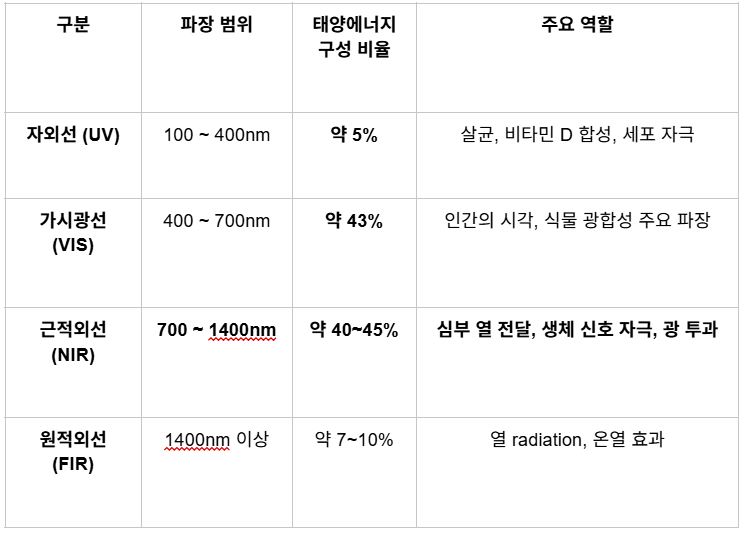
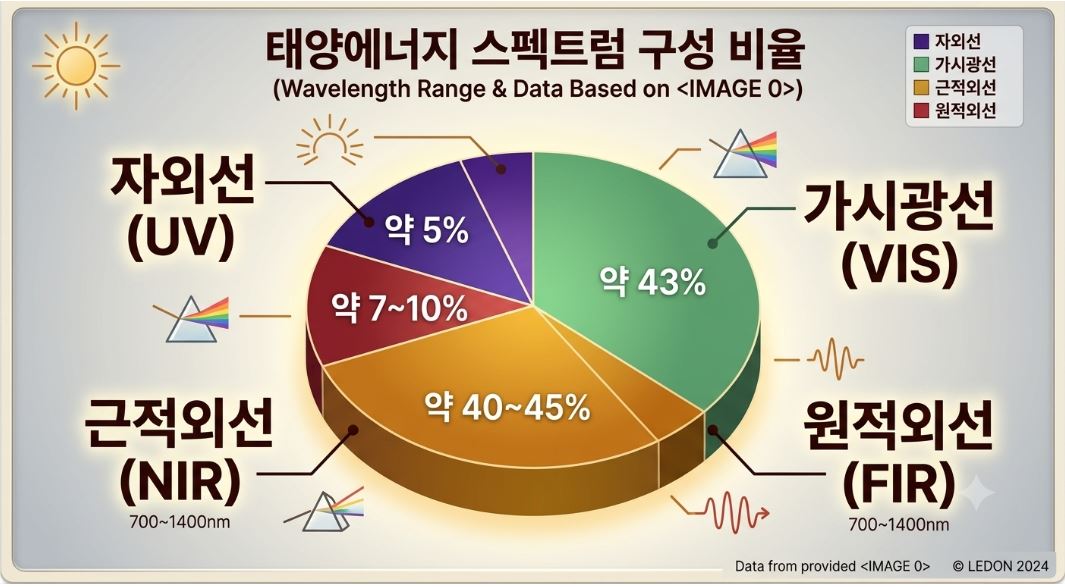
As shown in the table, about 40–45% of solar energy belongs to the near-infrared region. In other words, living organisms in nature have evolved while absorbing a much higher proportion of NIR than humans typically realize.
3. Why Focus on the 700~1000nm Band?
Among the entire infrared spectrum, the 700–1000nm wavelength band is considered a ‘golden band’ in industrial and optical technologies.
① ‘Emerson Effect’ & Fundamental Plant Growth Stimulation (Far-Red & NIR)
While plants were traditionally thought to perform photosynthesis using only visible light (red/blue light in 400–700nm), adding light in the 700–750nm band (Far-Red/NIR region) triggers the Emerson Enhancement Effect, dramatically boosting photosynthetic efficiency.
② The ‘Biological Optical Window’ with Highest Light Penetration
Light in the 700–1000nm range is less absorbed by water and blood (hemoglobin), allowing it to penetrate deeper into skin and plant tissue structures. Known as the Biological Optical Window, this property serves as a foundational element for bio-lighting and smart agriculture.
4. Why NIR is Difficult to Replicate in Artificial Light Sources
While NIR is abundant in natural sunlight, conventional artificial LED lighting is primarily engineered to emit light strictly within the visible light range to maximize luminous efficacy (lumens per watt).
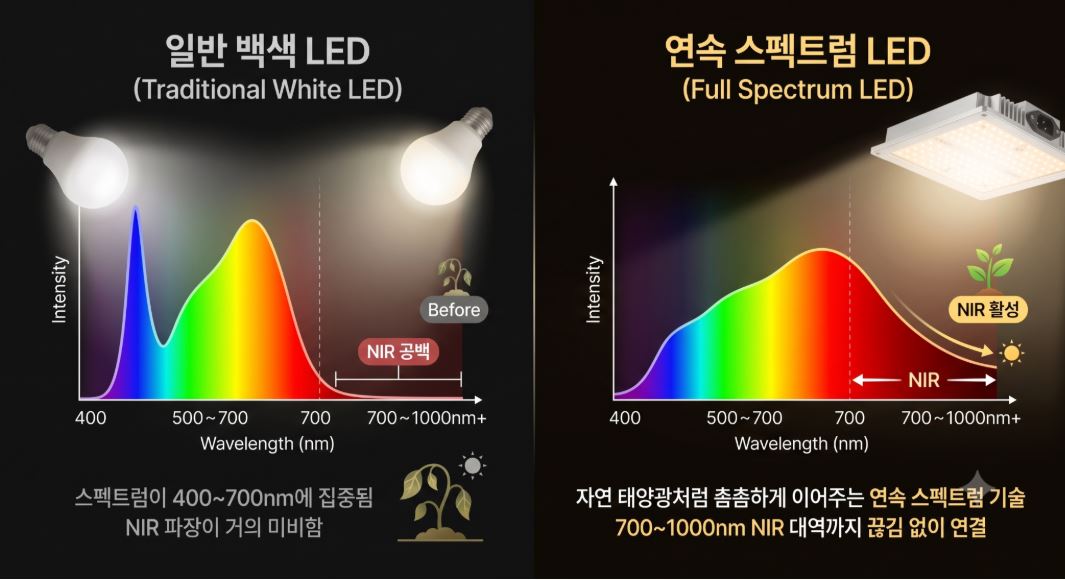
- Standard White LED: Energy is concentrated within 400–700nm, leaving the NIR spectrum virtually absent.
- Need for Continuous Spectrum (Full Spectrum) Technology: Advanced lighting technology is required to seamlessly cover the 700–1000nm NIR band without spectral gaps, mimicking natural sunlight.
5. Conclusion: Unseen Light Driving Future Technology
Near-Infrared (NIR) is more than just ‘invisible light’—it is a vital component that completes the full energy profile of natural sunlight. As interest grows in optimizing crop yields, low-power high-efficiency smart farms, and bio-lighting applications, the technological value of precise NIR spectrum control continues to rise.
LEDON Co., Ltd. leads the smart agriculture and next-generation optical technology markets with its Continuous Spectrum and Bio-Light technology, spanning from visible light to the Near-Infrared (NIR) spectrum.